
























For centuries, the construction industry was defined by traditional, on-site methods, often associated with slow, costly, and complex processes. The rise of off-site solutions, such as the prefabricated house or the versatile light steel house, began to challenge these norms by improving speed and efficiency. Now, a new evolution is taking this off-site concept to its technological peak. At the intersection of advanced manufacturing and design, a full-scale revolution is underway: 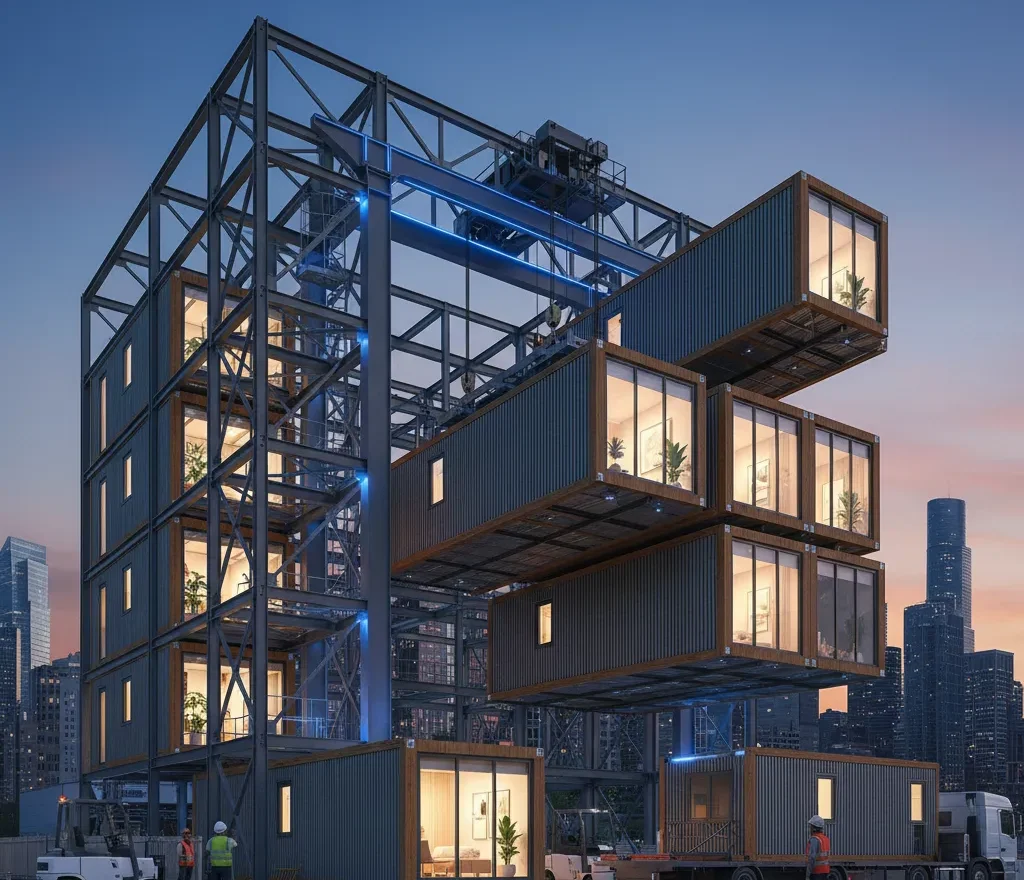 .
.
This approach fundamentally shakes the industry by centering on “manufacturing” entire 3D rooms in a controlled factory environment, rather than just “building” on-site. On-site delays, dependency on weather, material waste, and budget overruns have become the nightmare of many traditional projects. Volumetric modular construction directly addresses these challenges. So, what exactly is this innovative methodology, and why is it a game-changer?
In this comprehensive article, we will explore in detail what volumetric modular structures are, how the process works, the immense advantages they offer, and Pramo Prefabricated’s expertise in this field.
What is Volumetric Modular Construction? Basic Concepts
In its simplest terms, volumetric modular construction is an “off-site” manufacturing method based on producing three-dimensional (3D) volumetric units (modules) that make up a building in a factory, complete with all interior and exterior details, and then transporting and assembling them on-site.
This is far more than simple panel-based prefabrication.
The Difference from Traditional Construction and Prefabrication
In traditional construction, everything (bricks, cement, plumbing) is assembled from scratch, piece by piece, on the construction site. Panel-based prefabrication (2D) produces two-dimensional components like walls and floors in a factory, but the main “construction” and assembly still largely take place on-site.
Volumetric modular construction, however, changes the game. The “volumetric” modules referred to here are the actual rooms of a building. For example:
- A hotel room (including its bathroom, bed, and fixtures)
- A hospital intensive care unit
- A residential kitchen and bathroom pod
These 3D modules are completed to 90-95% in the factory. Everything from electrical wiring and outlets to flooring, bathroom fixtures, and sometimes even furniture is installed. The only job left for the site is to place these finished “Lego pieces” onto a pre-prepared foundation using a crane and “stitch” them together.
Advantages Shaping the Future of Construction: Why Volumetric Modular?
The rapid adoption of this methodology is due to the tangible and measurable benefits it offers. In every area where traditional methods get stuck, volumetric modular construction provides a solution.
1. Speed: Up to 50% Time Savings with Parallel Progress
The biggest constraint of traditional construction is its “sequential” nature. You cannot move on to the rough construction before the foundation is finished, nor to the finishing work before that is done.
The volumetric approach allows for “parallel” progress. While excavation and infrastructure work are being carried out on-site, the modules of your building are being manufactured at the same time in a factory miles away. This shortens project timelines by 30% to 50%. A project completed faster, especially for hotels, hospitals, or residential projects, means a much faster return on investment (ROI).
2. Quality: The Power of Factory Control
A construction site is a chaotic environment. Coordination between different teams, changing weather conditions (rain, mud, extreme heat), and variations in workmanship can cause fluctuations in quality standards.
Volumetric modular construction brings the entire production process into the discipline of a car factory:
- Controlled Climate: Materials are never affected by weather conditions.
- Quality Assurance (QA/QC): Each module undergoes hundreds of checkpoints, including tests for leaks, plumbing, and electrical systems, before it leaves the factory.
- Standardization: Every joint and detail is ensured to comply precisely with engineering calculations.
The result is a level of precision and consistent high quality that is nearly impossible to achieve on-site.
3. Cost Efficiency and Predictable Budgets
At first glance, the “material” cost of modular structures may seem similar to traditional methods, but the picture changes when looking at the total project cost.
- Less Labor: The need for on-site labor is dramatically reduced. This is a huge advantage, especially in regions where skilled labor is hard to find.
- Near-Zero Waste: Material usage is optimized in the factory setting. Waste from cutting, fitting, and spills on-site is reduced by up to 90%.
- No Budget Deviations: Because the project timeline is clear and production conditions are standard, “unexpected” costs and delay penalties are eliminated. Your budget is locked in from day one of the project.
4. Sustainability and Green Construction
The construction sector is responsible for a massive portion of the world’s carbon emissions and solid waste. Volumetric modular construction is a step ahead in this regard as well. It means less material waste, less transportation (transporting finished modules instead of constantly shipping materials to the site), and less site pollution (noise, dust). Furthermore, the high-precision modules produced in the factory provide better insulation and air-tightness, which lowers the building’s energy bills throughout its life.
5. Superior Safety
Construction is one of the most dangerous industries. Falls from height, handling heavy materials, and hazardous site conditions pose serious risks. Moving production to the factory floor eliminates almost all of these risks. Workers operate at ergonomic stations, at ground level, and in a safe environment.
How Does the Volumetric Modular Construction Process Work?
The success of this innovative process relies on a different mindset than traditional construction, based on the “DfMA” (Design for Manufacturing and Assembly) principle.
- Phase 1: Design and Engineering (DfMA): Everything starts in the digital realm (BIM – Building Information Modeling). Architects and engineers meticulously plan how the building will be divided into modules, the utility connections, and the transport/assembly logistics. The design must be “locked in” at this stage, as changes are difficult once production begins.
- Phase 2: Factory Production (Off-Site): The approved designs enter the production line. Steel or timber frames are built, utilities are run, insulation is installed, and interior/exterior finishes are completed. Each module is quality-checked before moving to the next station.
- Phase 3: Logistics and Transport: The completed modules, wrapped in protective covering, are shipped to the site on specialized transporters. This is one of the most critical logistical operations in the volumetric modular construction process.
- Phase 4: On-Site Assembly: This is the most spectacular and fastest part of the process. Modules are placed onto the prepared foundation by a crane, often in a matter of hours or days. It’s possible to watch an apartment block rise before your eyes.
- Phase 5: Stitching and Commissioning: Once the modules are set, teams make the inter-module connections for mechanical, electrical, and plumbing systems. The exterior joints are sealed, and the building is connected to the main utilities, making it ready for handover.
What Are the Applications of Volumetric Modular Construction?
The flexibility of this technology makes it suitable for almost any type of building, but it particularly shines in certain areas:
- Hospitality and Accommodation: Uniform, repetitive hotel rooms are a perfect candidate for volumetric modular construction. It is critical for the project to be completed quickly and start generating revenue.
- Multi-Story Housing and Student Dorms: It offers fast, high-quality solutions to housing needs, especially in urban areas.
- Healthcare Facilities: Hospitals, clinics, and laboratories with high technical requirements and where hygiene is critical can be produced flawlessly under factory control.
- Educational Institutions: Schools and classrooms often need to be completed within tight timeframes, such as holiday breaks.
- Data Centers: The precise and rapid installation needs of these high-tech structures are perfectly met by this method.
<h2>Challenges and Future Vision</h2>
Like any revolutionary technology, volumetric modular construction also faces some challenges. Chief among these are the industry’s traditional mindset, the perception of “prefab” as low quality (which this method is the exact opposite of), and logistical constraints in transport.
However, the future is bright. As sustainability targets, skilled labor shortages, and cost pressures increase, the industry is inevitably turning towards factory production. With the integration of robotic automation into factory processes, volumetric modular construction will become even more efficient and flawless.
Pramo Prefabricated: Your Assurance in Volumetric Modular Solutions
To catch the construction methodology of the future today requires the right vision and a strong engineering infrastructure. At Pramo Prefabricated, we are here to apply all the advantages of volumetric modular construction technology to your projects. We combine our years of experience with the discipline of our modern production facilities.
If you are tired of the uncertainties, delays, and hidden costs of traditional construction, and you want to redefine your project on an axis of speed, quality, and sustainability, you are in the right place.
Carry Your Project into the Future
Whether it’s a hotel, a residential project, or a special-purpose industrial facility, we can maximize your project’s potential with our volumetric modular construction solutions. The expert team at Pramo Prefabricated is with you at every step of the process, from design to turnkey delivery.
In Conclusion;
Volumetric modular construction is not just a trend; it is the inevitable evolution of the construction industry. It is the only methodology that simultaneously answers the critical challenges of speed, quality, cost control, and sustainability. The time has come to leave the chaos of the construction site behind and move to the clarity and efficiency of factory production.
Contact us today to discuss how we can use this revolutionary approach in your projects, and let’s build the buildings of the future together.