





















Growing student populations, new education investments and projects that must become operational quickly are increasing demand for alternative construction methods. Prefabricated school buildings offer a practical solution by combining factory-controlled production, flexible layouts and faster on-site assembly.
A prefabricated school does not have to be a temporary structure containing only a few classrooms. With proper architectural and engineering planning, classrooms, administrative offices, laboratories, libraries, dining areas and social spaces can all be incorporated into the same building system.
What Is a Prefabricated School Building?
Prefabricated school buildings are produced by manufacturing significant structural components away from the final construction site and assembling them on location. The principles of prefabrication allow part of the construction process to take place in a controlled production environment.
Pramo’s prefabricated social buildings include solutions suitable for education facilities and school projects with different functional requirements.
Why Should Capacity Be Defined First?
The number of students expected to use the building simultaneously is one of the first parameters to define.
Student capacity directly affects:
- Number of classrooms
- Corridor dimensions
- Administrative areas
- Restrooms
- Dining facilities
- Social and common spaces
Future expansion should also be considered. One advantage of prefabricated and modular systems is that a building can be planned with future development in mind.
How Should Classrooms and Common Areas Be Organized?
Efficient circulation is essential in school design. Students and staff should be able to move easily between classrooms, administrative departments and shared facilities.
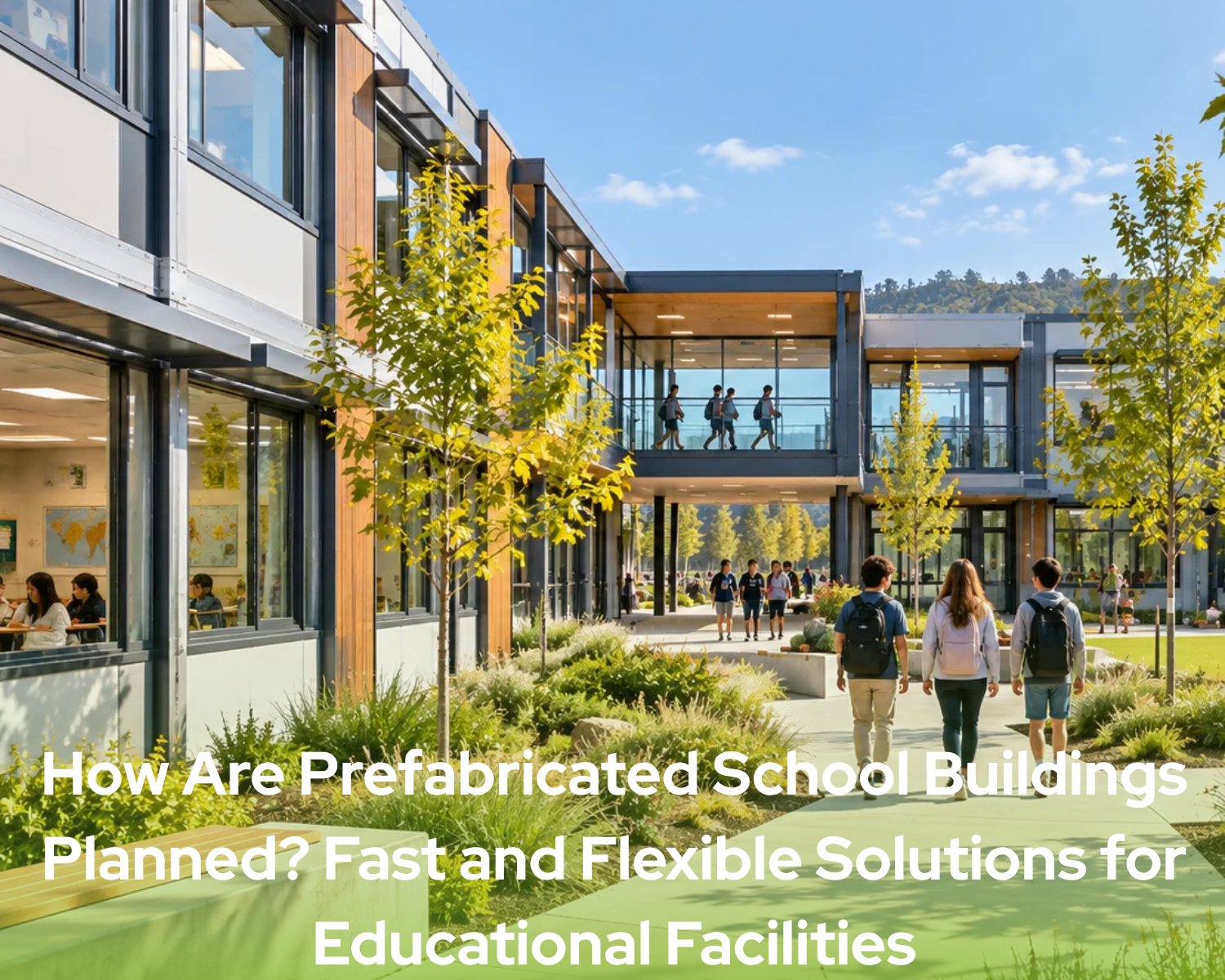
Depending on project requirements, a prefabricated school may include classrooms, teachers’ offices, laboratories, libraries, dining halls, technical rooms and multipurpose spaces.
The relationship between these areas should be determined according to the number and age of users as well as the educational program.
Why Are Thermal and Acoustic Performance Important?
Structural performance is only one aspect of an education building. Indoor comfort also plays an important role.
Appropriate wall and roof insulation systems can help maintain comfortable indoor temperatures throughout different seasons. Acoustic planning is equally important, particularly between classrooms and noisier facilities such as multipurpose halls or activity rooms.
Where Can Prefabricated Schools Be Used?
Prefabricated education buildings can be considered for new schools, additional classroom requirements, rural education facilities, campuses and locations where additional capacity is needed within a limited schedule.
Pramo’s portfolio of completed projects demonstrates how prefabricated and modular technologies can be adapted to projects of different scales and functions.
What Should Be Evaluated Before Choosing a Prefabricated School?
A project should not be evaluated only according to its initial square-meter cost.
The structural system, insulation, electrical and mechanical infrastructure, windows and doors, foundation preparation, transportation and installation requirements should all be reviewed as part of the complete project.
Can a prefabricated school be used as a permanent building?
Yes. When designed according to the intended use, engineering requirements and applicable local regulations, prefabricated school buildings can be developed for long-term use.
Education Buildings Designed Around Project Requirements
Every education project has different capacity requirements, site conditions and operational needs. For this reason, project-specific planning is generally more effective than simply selecting a standard building.
Pramo Prefabricated combines engineering, production and installation experience to develop functional and efficient education facilities for projects in Türkiye and international markets. From additional classrooms to complete school campuses, prefabricated systems can provide a flexible approach to modern education infrastructure.